
Few situations cause more stress for a small business owner than having to discipline an employee. You worry about getting the process wrong. You worry about the relationship breaking down. And in the back of your mind, you worry about the dreaded letter from ACAS that signals a Tribunal claim is on its way.
If you run a business in Exeter, or anywhere in the wider Devon area, you are not alone in feeling this way. We speak to employers every week who have either avoided dealing with an issue for too long, or charged in without a process and made it worse. This guide walks you through how to handle a disciplinary properly, in plain language, so you protect your business and treat your employee fairly at the same time.
Why disciplinaries go wrong
In our experience working with Exeter businesses, disciplinaries usually go wrong for one of four reasons. The employer reacts emotionally rather than systematically. The process is rushed. The paperwork is missing or contradictory. Or the wrong person inside the business runs the meeting.
The good news is that all four are avoidable. A fair disciplinary is not about being soft or being harsh. It is about following a clear, defensible sequence of steps that gives the employee a fair hearing and gives you a clear record of why you made the decision you made.
The legal framework: the ACAS Code of Practice
The starting point for any disciplinary in the UK is the ACAS Code of Practice on Disciplinary and Grievance Procedures. It is not law in the strict sense, but Employment Tribunals are required to take it into account. If a Tribunal finds you have unreasonably failed to follow the Code, it can increase any compensation award by up to 25 per cent. Conversely, if the employee has unreasonably failed to follow it, the award can be reduced by up to 25 per cent.
So the Code matters. It is also short, readable, and sensible. If you have not read it in the last twelve months, read it again.
Step one: establish the facts before you do anything
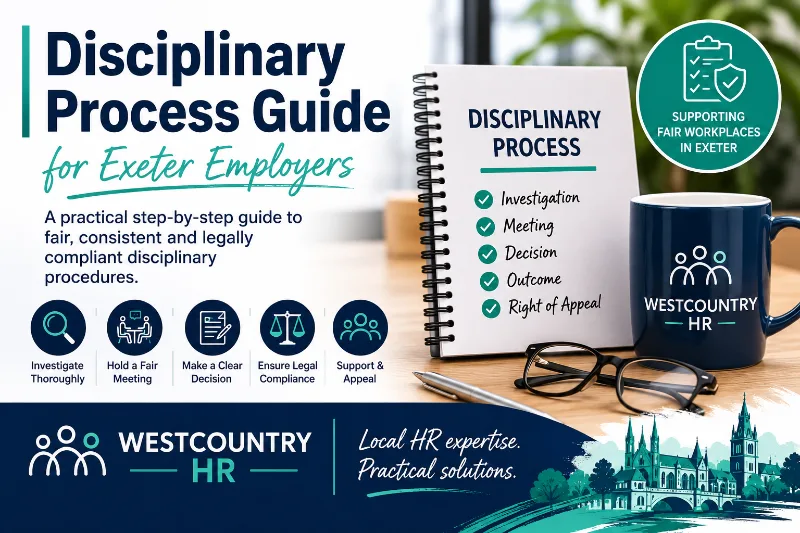
Before you label something a disciplinary matter, find out what actually happened. This is the investigation stage and it is where most Exeter employers we work with rush. A proper investigation involves:
- Speaking to the people who saw or were involved in the incident
- Reviewing any relevant documents, emails, CCTV, or records
- Taking written notes of every conversation
- Keeping the investigation separate from the disciplinary itself
The person investigating should ideally not be the same person who will chair the disciplinary meeting later. In a small Exeter business that can be hard, but even bringing in a second director, manager, or external HR advisor to chair the meeting helps preserve fairness.
At this stage you might also consider whether to suspend the employee. Suspension is not a punishment and should never be treated as one. It is a precaution, used only where there is a genuine reason such as risk to others, risk to evidence, or risk to the business, and it should be on full pay and for the shortest period possible. Always confirm a suspension in writing and explain why.
Step two: decide whether there is a case to answer
Once the investigation is complete, look at what you have. Is there a reasonable case that the employee has done something that warrants formal action? If the answer is no, tell them so, document the decision, and close the matter. Do not invent a case to save face.
If the answer is yes, decide what level of action is potentially in play. The usual categories are:
- Informal action: a quiet word or written file note
- First written warning
- Final written warning
- Dismissal, with or without notice depending on whether it is gross misconduct
Be honest with yourself about what level you are likely to be dealing with. This matters because the seriousness of the potential outcome dictates how careful you need to be with the process.
Step three: invite the employee to a disciplinary hearing
The invitation should be in writing. It needs to do four things clearly:
- Set out the specific allegations in plain language
- Explain that the matter is being dealt with formally under your disciplinary procedure
- Provide copies of any evidence you intend to rely on, including witness statements
- Inform the employee of their right to be accompanied by a colleague or trade union representative
Give the employee reasonable time to prepare. Two to five working days is a sensible range in most cases. Do not hold the hearing the day after the invitation goes out. That alone has cost more than one Exeter employer a Tribunal claim.
Tell them what the possible outcomes are, including dismissal if that is on the table. The employee has a right to know what they are facing.
Step four: hold the hearing properly
The hearing should be in private, with a note taker present. The structure is straightforward:
- Introduce everyone in the room and explain the process
- Set out the allegations and the evidence
- Allow the employee to respond fully, ask questions, and put forward their version of events
- Adjourn before making any decision
Do not announce the outcome in the meeting. Take time to consider. Even if you think you know what the answer is, a short adjournment shows you have weighed it carefully. In a Tribunal a snap decision looks like a predetermined one.
Step five: communicate the outcome in writing
Once you have decided, write to the employee. The letter should:
- Confirm the decision and the reasons for it
- Explain any sanction and how long it stays on file
- Set out what is expected going forward
- Confirm the right to appeal and how to do so
The right of appeal is not optional. Every employee subject to a disciplinary sanction in the UK has a right to appeal it. The appeal should ideally be heard by someone not previously involved in the decision.
Special considerations for gross misconduct
Gross misconduct is conduct so serious that it fundamentally breaks the employment relationship. Common examples include theft, violence, serious dishonesty, gross negligence, and serious breaches of health and safety. In these cases summary dismissal, meaning dismissal without notice or pay in lieu, can be appropriate.
But, and this is critical: gross misconduct still requires a fair process. The Employment Rights Act framework does not allow a shortcut just because the allegation is serious. If anything, the more serious the allegation, the more important it is that the process is watertight.
We have seen Exeter employers convinced they had a clear cut case for gross misconduct dismissal, only to lose at Tribunal because they skipped the investigation, did not let the employee respond, or chaired the appeal with the same person who chaired the original hearing. Process protects you.
Common Tribunal pitfalls
Over the years, the same mistakes come up again and again. Watch for these:
- Predetermining the outcome before the hearing
- Failing to disclose evidence to the employee in advance
- Refusing a reasonable request to be accompanied
- Using the same person to investigate, hear, and decide the appeal
- Inconsistent treatment, such as disciplining one employee for behaviour you tolerated in another
- Letting personal feelings drive the outcome
- Sloppy paperwork or no paperwork at all
When to bring in HR support
There is no shame in asking for help. A disciplinary that ends in dismissal will cost you a lot more in legal fees and Tribunal exposure than a few hours of HR advice up front. We routinely support Exeter businesses through disciplinary processes by:
- Reviewing the situation and giving you an honest read on the strength of the case
- Drafting investigation plans and invitation letters
- Chairing or sitting in on hearings as an independent voice
- Reviewing outcome letters before they go out
- Advising on appeals
This is exactly the kind of work our HR consultancy retainer covers. Clients can pick up the phone, talk through a situation as it develops, and get clear advice in plain English rather than legal jargon.
Get a free HR Healthcheck for your Exeter business
If you are not sure whether your disciplinary policy is up to date, or whether your contracts and handbook support the kind of process described above, book a free HR Healthcheck with Westcountry HR. We are based in Newton Abbot, twenty minutes from Exeter, and we work with businesses right across the city and the surrounding area.
There is no cost and no obligation. You get an honest review of where you stand and a clear set of next steps. Call 01626 367595 or email hello@westcountryhr.com to book yours.